Platform Bed Frames: What to Know Before You Buy
A platform bed frame supports a mattress directly on slats or a solid base, usually without a box spring. Match the support to your mattress, then compare the full bed height, room footprint, weight limit and access needs.
On this page (13 sections)
- What is a platform bed frame?
- How does a platform bed differ from a panel bed?
- Which platform bed support type should you choose?
- How do you check mattress fit and support?
- How high should a platform bed sit?
- Which platform bed materials and styles fit your room?
- Should you choose a platform bed with storage?
- What should you measure before buying?
- Which platform bed frame features matter most?
- Which platform bed frame suits each buyer?
- How do you set up and care for a platform bed?
- What common platform bed buying mistakes should you avoid?
- How do you choose the right platform bed frame?
A platform bed frame supports a mattress directly on slats or a solid base, usually without a box spring. To choose one, match its support to your mattress, measure the room and access route, and compare total bed height, storage and assembly needs.
Platform frames range from low wood designs to open metal bases, upholstered beds with headboards and lift-up storage frames. Each can suit a different bedroom, but the right choice depends on the mattress, room layout and how you use the space.
This guide explains how to compare support styles, fit, height and practical features, then weighs four queen frames against different needs. Start with platform bed slat spacing if you're deciding whether a mattress can rest on slats.
What is a platform bed frame?
A platform bed frame holds a mattress on a built-in support surface, commonly slats, a metal grid or a solid deck. Many are designed to support the mattress without a box spring, which can simplify setup and affect the bed's finished height.
Slats leave gaps beneath the mattress, while a solid deck gives it a more continuous surface. Neither design is automatically right for every mattress, since the mattress maker may set rules for airflow, spacing or center support.
“Platform” describes how the mattress is supported, not a single style or height. A frame may also have a headboard, footboard, storage or none of those features.
How does a platform bed differ from a panel bed?
A platform bed usually supports the mattress directly, while a traditional panel bed often uses a separate foundation. Names can overlap, so check which support parts the frame includes before buying.
A panel frame may have side rails, a headboard and a footboard, with a box spring carrying the mattress. Some panel-style beds include slats instead, so the style name alone does not tell you whether you need a foundation.
Read our platform bed vs panel bed comparison if you're choosing between those frame styles.
Which platform bed support type should you choose?
Choose the support surface that meets your mattress maker's requirements and fits your setup preferences. Slats, solid platforms and metal grids differ in spacing, airflow and the way they meet the mattress.
| Support type | What it offers | Check before buying |
|---|---|---|
| Wooden slats | Separate supports across the frame | Slat spacing, center support and mattress approval |
| Solid platform | A broad, continuous support surface | Mattress compatibility and airflow guidance |
| Metal grid or bars | A firm support structure with open space below | Bar spacing, contact points and mattress requirements |
| Foldable metal base | A frame that folds for moving or storage | Stability, open footprint and mattress support rules |
Start with the mattress instructions, not a general rule about bed frames. Compare the approved base type, slat gap and center support with the frame's design before making a choice.
If you need help matching a mattress to a base, see which mattress works best on a platform bed.
What platform bed slat spacing works for your mattress?
Use the maximum slat gap specified by your mattress maker. If the instructions do not give a clear limit, ask the maker before placing the mattress on widely spaced slats.
Measure the open space between slats, not the width of each slat. Also check whether the frame includes a center rail and support legs, and whether your mattress requires them.
Our guide to how far apart platform bed slats should be explains how to measure and compare the gaps.
How can you keep a mattress from sliding?
A mattress is less likely to shift when its size matches the frame and the support surface has secure contact points or retainers. Assemble the frame fully, check its fit and use any stops or non-slip features that come with it.
Avoid adding a thick liner without checking whether it could affect airflow or conflict with the mattress instructions. If the mattress still moves, try the suggestions in how to keep a mattress from sliding on a platform bed.
How do you check mattress fit and support?
Check mattress size, support rules and frame capacity before choosing a platform bed. A mattress labeled queen still needs to match the frame's intended size and rest on an approved support surface.
Use the size printed on the mattress label or in its instructions. Compare it with the frame's stated mattress fit and, when available, the inside dimensions of the frame.
For slatted bases, use the mattress maker's maximum gap as your limit. Some foam mattresses require closer support than others, so a general spacing rule may not fit the mattress you own.
Check for a center rail or support legs, especially on wider frames. The mattress, sleepers and other loads all count toward the frame's stated weight recommendation.
If you expect a heavy combined load, compare the frame's limit and support design with our guide to platform bed weight capacity.
How high should a platform bed sit?
The finished bed height is the frame's mattress support height plus mattress thickness. Measure from the floor to the top of the mattress, then consider getting in and out, headboard proportions and clearance beneath the bed.
A low frame can leave more visual space above the bed, but the lower sitting position may be harder for some people to use. A higher frame can make it easier to sit down and stand up, though it may limit access to a window or make the room feel more crowded.
Don't use the outer rail height as the finished bed height. Our guide to choosing a bed frame height walks through the measurements.
Which platform bed materials and styles fit your room?
Choose a material and style that fit the room and the care you want to manage. Wood, metal and upholstery change the look and construction of a frame, but don't replace the need to check its support details.
Wood frames may show natural grain or have a painted finish. Metal designs can have an open profile or folding parts, while upholstered frames cover parts of the structure in fabric and may include a padded headboard.
Consider where the frame will sit and what it will touch. Think about how you'll clean it, then compare the slats, rails, feet and center supports.
A fabric headboard, for example, needs different care from a steel frame.
For a direct material comparison, read wood vs metal bed frames. If you prefer fabric-covered surfaces, see our upholstered platform bed guide.
Should you choose a platform bed with storage?
Choose storage when you have a clear use for it and enough room to reach it. Open clearance suits bins, drawers need room to slide, and lift-up frames need space for the base to rise.
Measure the open space beneath a frame and compare it with your bins and the items you want to store. For drawers, check the space between the bed and nearby walls or furniture so they can extend fully.
A lift-up frame provides access beneath the mattress through a raised base. Consider where you'll stand, how you'll reach inside and whether bedding or a rug could get in the way.
Storage may change the bed's height, weight and assembly needs, so compare the full setup with your room. Our guide to platform beds with storage drawers covers drawer options alongside other storage styles.
What should you measure before buying?
Measure the room, full frame footprint, access route and usable space around the bed. A frame can match your mattress and still crowd the room or be difficult to carry through a doorway.
Measure the room's width and length, then mark the planned bed footprint, including any headboard and footboard. Leave enough room to walk and to open doors, closet drawers and bedside furniture.
Check the route from the entrance to the bedroom, including hallway turns and stairs. Compare its narrow points with the frame's package dimensions, or check whether the frame arrives in parts.
For storage models, measure the clearance or drawer travel. For a lift-up bed, account for the space needed to raise the base and reach into the storage area.
Before choosing a larger size, use our queen vs king bed guide to compare the room each size needs.
Which platform bed frame features matter most?
Prioritize features that solve a real problem in your room. A headboard, folding design or storage mechanism changes how you use the frame, so check its fit and access requirements.
- Headboard: Check its height and width, and how it attaches to the frame. If you plan to add one later, read how to attach a headboard to a platform bed.
- Foldable frame: Confirm how it folds and where you'll store it, then check the open footprint against the room.
- Under-bed clearance: Compare the floor-to-frame space with your bins or cleaning tools.
- Upholstery: Consider the fabric surface and the care instructions before placing the bed near a wall or window.
- Noise-control details: Follow directions for features such as non-slip tape or a mute bar, and check fasteners if sounds develop.
- Lift-up storage: Make sure the access method suits your reach and daily routine.
A feature matters when it fits the way you live. A tall headboard can change the room's proportions, and a storage mechanism can reduce easy access to the space under the bed.
Which platform bed frame suits each buyer?
The best frame for you depends on what you need to solve first: simple wood support, an upholstered look, easier movement or enclosed storage. These four queen options illustrate those trade-offs.
Mellow Naturalista Classic Queen
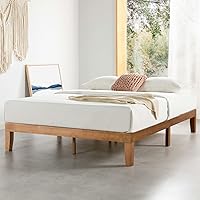
The Mellow Naturalista Classic Queen suits shoppers who want a straightforward wood frame with slats and no box spring. Its solid wood frame measures 3.5 in thick, and the frame is 12 in high with 8.5 in of ground clearance.
It measures 79.5 in long by 59.5 in wide and has a maximum weight recommendation of 1,000 lb. That clearance may fit some storage bins, but measure them against the space you have.
Choose it if a wood look and open space beneath the bed suit your room. Skip it if you need an upholstered headboard, enclosed storage or a folding frame, and confirm that the slat spacing fits your mattress.
Allewie Upholstered Platform Bed Queen
The Allewie Upholstered Platform Bed Queen suits shoppers who want a fabric headboard and a wood-slat support surface. It combines metal, wood and fabric, and its maximum weight recommendation is 800 lb.
The frame measures 81.5 in long, 60.83 in wide and 43.5 in high, with 4.3 in of ground clearance. It is designed for mattresses 8 to 15 in thick, while Allewie also describes a fit range of 8 to 14 in.
Choose it if you want the headboard built into the bed and your mattress falls within the stated range. Skip it if you need ample under-bed storage, a low profile or a frame that folds for moving.
Amazon Basics Foldable Platform Bed Queen
The Amazon Basics Foldable Platform Bed Queen suits shoppers who want an open steel base with space beneath it. It folds for storage or moving through doorways and provides 13 in of under-bed clearance.
It measures 80 in long, 60 in wide and 14 in high. The maximum weight recommendation is 700 lb total, with a stated maximum of 350 lb per person.
Choose it if you want a simple metal support and useful clearance under the bed. Skip it if you want a headboard, fabric finish or enclosed storage, and check that the unfolded frame fits your room.
Allewie Lift Up Storage Bed Queen
The Allewie Lift Up Storage Bed Queen suits bedrooms where enclosed space beneath the mattress matters more than open access or drawers. Its fabric wingback headboard and lift-up base give the bed a more finished look while providing access to under-bed storage.
Its solid wood slats support the mattress without a box spring, and its maximum weight recommendation is 800 lb. The frame measures 84.25 in long, 63 in wide and 44.5 in high, so check the full footprint as well as the headboard height.
Choose it if you can use the lifting mechanism and want enclosed storage. Skip it if you need a light, compact frame or want to access items under the bed without raising the base.
How do you set up and care for a platform bed?
Follow the frame's instructions and assemble it on a clear, level surface. Correctly placed slats, fully seated supports and feet that reach the floor help the frame sit evenly.
Before you begin, sort parts and group the hardware by assembly step. Check that the instructions match the frame and keep the parts list nearby so you can account for every support and fastener.
Assemble the rails and support pieces in the order shown. Don't substitute screws or skip a support because the frame appears stable before you add the mattress.
Tighten connections as directed, then check that the frame is level and the slats or base are fully seated.
After placing the mattress, check that it rests inside the frame and doesn't rock or slide. Follow the care instructions for the frame's materials, and recheck fasteners if the frame shifts or makes noise later.
For a more detailed walkthrough, read how to put a platform bed together. If a metal bed develops a squeak, see how to stop a metal bed frame from squeaking.
What common platform bed buying mistakes should you avoid?
The most common mistakes are choosing by appearance alone, overlooking the mattress maker's support rules and measuring only the mattress. A short pre-buy check can help you avoid a frame that doesn't fit or work with your setup.
- Assuming every mattress works on slats: Check the mattress instructions for maximum spacing and center support.
- Using the listed size as the whole footprint: Include the headboard, footboard and any frame overhang in your room measurements.
- Forgetting the route into the room: Check hallways, corners, stairs and package dimensions before choosing a frame.
- Ignoring finished height: Add mattress thickness to the support height before deciding whether the bed will be easy to use.
- Buying storage without checking access: Measure bin height, drawer travel or the space needed to raise a lift-up base.
- Treating a weight limit as a target: Compare the total load with the frame's stated recommendation and avoid exceeding it.
- Rushing assembly: Missing supports, loose hardware or an uneven setup can lead to shifting and noise.
The right choice is the one that clears these checks and fits your priorities. If a frame fails the mattress support check, move on even if its style and storage look right.
How do you choose the right platform bed frame?
Choose a platform bed frame by matching mattress support first, then narrowing your options by fit, height, storage, style and setup. Measure the room and route, check the total load, and decide which features you will use regularly.
Choose the Mellow Naturalista Classic if you want a simple wood slat frame with open clearance. Choose the Allewie upholstered frame if a padded headboard is a priority, the Amazon Basics frame if folding and open storage matter, or the Allewie lift-up bed if you need enclosed storage beneath the mattress.
Before you decide, compare your mattress requirements with platform bed slat spacing and review which mattress works best on a platform bed.
Frequently asked questions
What is a platform bed frame?
A platform bed frame supports a mattress directly on slats, a metal grid or a solid base. Many designs work without a box spring, but the right support depends on the frame and mattress.
Check the mattress instructions for allowed base types, slat gaps and center support before setting up the bed.
Do you need a box spring with a platform bed?
Usually, no. Platform frames are designed to carry the mattress on their own support surface, such as slats or a deck.
Confirm that your mattress allows that surface and that any slat-spacing and center-support rules are met.
Adding a box spring also raises the finished bed height.
Are platform beds good for memory foam mattresses?
They can be, if the frame meets the mattress maker's support rules. Check the mattress instructions for approved base types, maximum slat spacing and center support, then compare those requirements with the frame.
A frame's platform label alone does not confirm a match for every foam mattress.
How do you choose the right platform bed height?
Add the frame's support height to the mattress thickness to estimate the top of the bed. Then consider how easily you can sit down and stand up, whether the headboard fits below the ceiling or window, and how much room you want beneath the frame.
Measure the assembled bed, not just its side rail.
Can a platform bed have storage underneath?
Yes. Some platform frames leave open clearance for bins, while others use drawers or a lift-up base to reach enclosed space.
Measure the space and the items you want to store.
Also allow room for drawers to extend or for the lift mechanism to open and for you to reach inside.